

JoyaGoo Spreadsheet bin edges: a missing tenth day and days counted twice
The four bins look tidy until you lay their labels on a day axis. Five records skip day 10, four print a day twice, and every record ends in a bin with no upper limit.
Eleven different ways of cutting the days
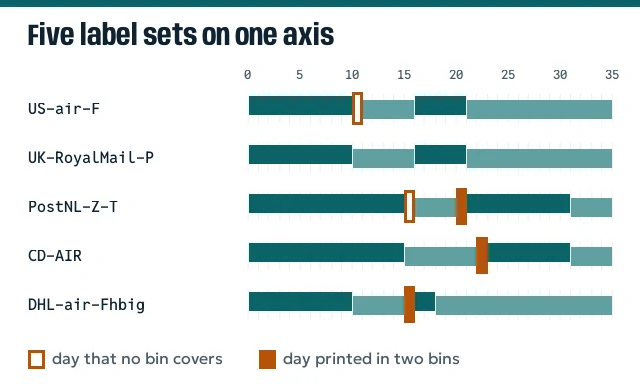
The 28 records do not share one set of bin labels. They use eleven. The most common, “<10 / 10-15 / 16-20 / >20”, covers eleven lines; seven label sets belong to a single line or pair. EMS-US cuts at 5, 8 and 12 days; EUB at 9, 15 and 25; CD-AIR at 15, 22 and 30.
Different cuts are not wrong in themselves. A slow postal line needs wider bins than an express one. But they make records hard to put side by side: the 16-to-20-day bin of one line and the 15-to-22-day bin of another do not describe the same days.
The most common set is shared by the three UK lines, both Canadian lines, the three Australian lines, both US-MG lines and CH-DPD-F. The standard DHL lines use a near copy of it that starts the second bin at 11 instead of 10.
| Bin labels | Lines | What happens at the edges |
|---|---|---|
<10 | 10-15 | 16-20 | >20 | 11 | every day covered once |
<10 | 11-15 | 16-20 | >20 | 5 | no bin for day 10 |
<10 | 10-15 | 15-17 | >17 | 3 | day 15 in two bins |
<10 | 10-13 | 14-17 | >17 | 2 | every day covered once |
<10 | 10-14 | 15-20 | >20 | 1 | every day covered once |
<15 | 15-22 | 22-30 | >30 | 1 | day 22 in two bins |
<15 | 15-22 | 23-30 | >30 | 1 | every day covered once |
<15 | 16-20 | 20-30 | >30 | 1 | no bin for day 15; day 20 in two bins |
<5 | 5-8 | 9-12 | >12 | 1 | every day covered once |
<8 | 8-11 | 12-15 | >15 | 1 | every day covered once |
<9 | 9-15 | 16-25 | >25 | 1 | every day covered once |
The tenth day that belongs to no bin
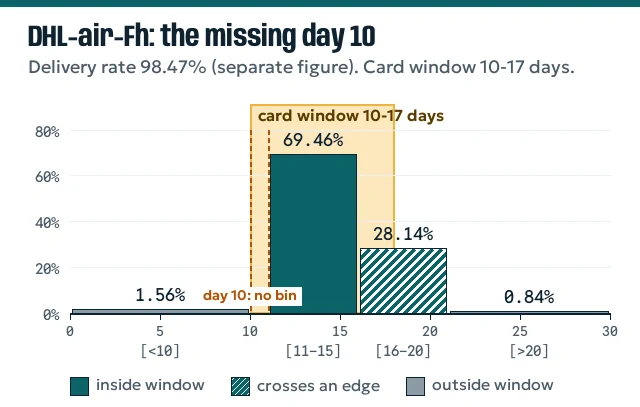
Five records run “<10” and then “11-15”: US-air-F, DHL-air-Fh, DHL-air-DD(Tax Free), DHL-air-TM and CH-DPD-P. Under 10 means day 9 and earlier. Eleven to fifteen starts at day 11. Read as printed, a parcel delivered on day 10 has nowhere to go.
There are two possible explanations. The underlying data might use fractions of a day, so that “under 10” means up to 9.99 and “11-15” quietly includes 10.0 to 10.99. Or the labels were simply typed carelessly. A 100 percent total alone cannot establish whether any day-10 parcels existed or how they were counted.
For reading purposes the gap is small. It matters because the printed ranges do not define that day; the record cannot explain how the underlying data was handled.
Days printed in two bins at once
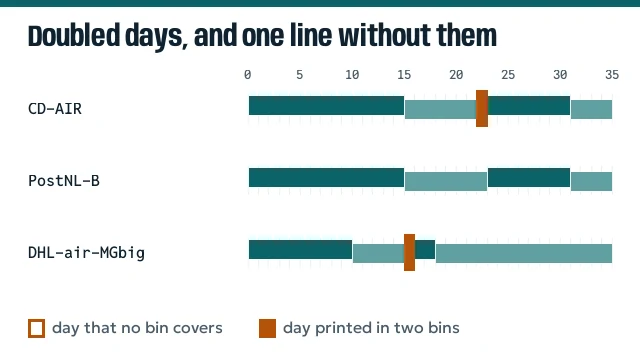
The opposite also happens. CD-AIR runs “15-22” and then “22-30”, so day 22 sits in both. The three large-parcel DHL lines (DHL-air-Fhbig, DHL-air-DDbig(Tax Free), DHL-air-MGbig) run “10-15” then “15-17”, so day 15 sits in both.
Shares that sum to 100 do not prove that the underlying groups are mutually exclusive; percentages could have been normalised. Which one is not knowable from outside. Compare PostNL-B, which uses almost the same cuts as CD-AIR but writes “23-30”, leaving no overlap. That is a difference in the published labels; the cause is not stated.
Where a doubled day falls on a window edge, it decides whether a bin counts as inside or across. The viewer treats the label literally and says so.
PostNL-Z-T: a gap and an overlap in one record
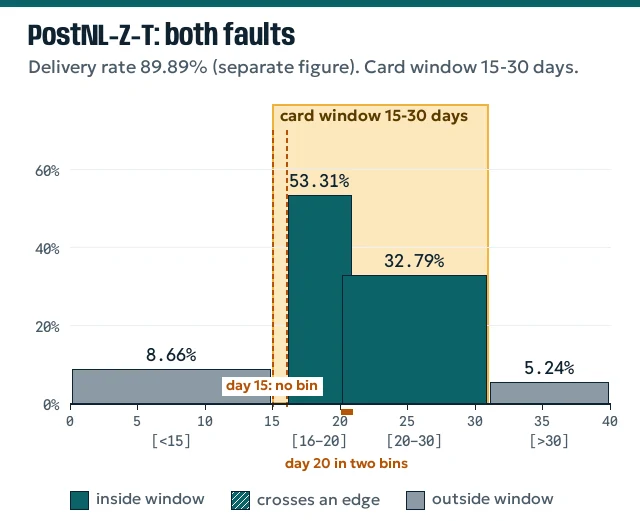
PostNL-Z-T manages both faults at once. Its labels read “<15”, “16-20”, “20-30”, “>30”. Day 15 is in no bin. Day 20 is in two.
It is also the line with the widest reach in our pull (28 destinations) and the lowest delivery rate (89.89 percent). Taken together, this is the record that most needs a definition and has both a gap and an overlap in the labels.
Against its 15-to-30-day card window, the two middle bins sit inside (86.1 percent of the record), the bin under 15 days sits before the window opens (8.66) and the bin over 30 after it closes (5.24). The gap at day 15 falls exactly on the window’s opening edge.
Read literally, that means a parcel delivered on day 15, the first day of the card window, appears in no bin at all, while a parcel delivered on day 20 could be counted in either of the two bins that sit inside the window. Neither fault moves much of the record across the window’s edges, but both sit on the line that appeared in 28 of our 32 destinations.
Open-ended first and last bins
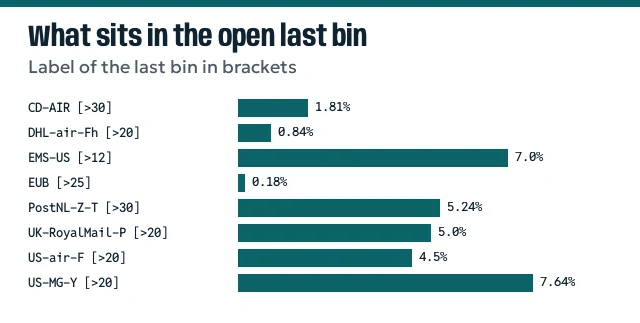
Every record starts with an open bin (“<5”, “<10”, “<15”) and ends with one (“>12” up to “>30”). The first is harmless: nobody minds early parcels. The last hides the part of the record that matters most to anyone waiting.
US-air-F reports a 4.5 percent share in “over 20 days”. That could mean day 21 or day 60. EUB’s last bin is “over 25” at 0.18 percent; CD-AIR’s “over 30” holds 1.81. The record gives no maximum and no median for the tail.
This is where the claim deadline becomes relevant. JoyaGoo stops accepting claims on day 45 counted from dispatch, and the record cannot tell you how many parcels in that last open bin got close to it.
What a whole-day reading can and cannot tell you
Everything on this page reads the labels as whole days, because that is how they are printed. A reader can fairly conclude three things from that: the labels were not drawn up to one standard, some have gaps or overlaps despite a 100 percent total, and the record’s tail is unbounded.
A reader cannot conclude that any parcel was lost in the gap, or that day-22 parcels on CD-AIR were counted twice. The totals cannot resolve either question. The faults are in the labels, not necessarily in the counting.
If JoyaGoo ever publishes the definitions, this page will be rewritten against them, and the change will be dated on the readings log.
Where the edges meet the card: