

JoyaGoo Spreadsheet card windows and the bins that cross their edges
The window on the card and the bins in the data were not cut by the same hand. On some lines they agree almost perfectly; on the two Canadian lines not one bin fits inside the window.
What the result card shows: Estimated Transit Time
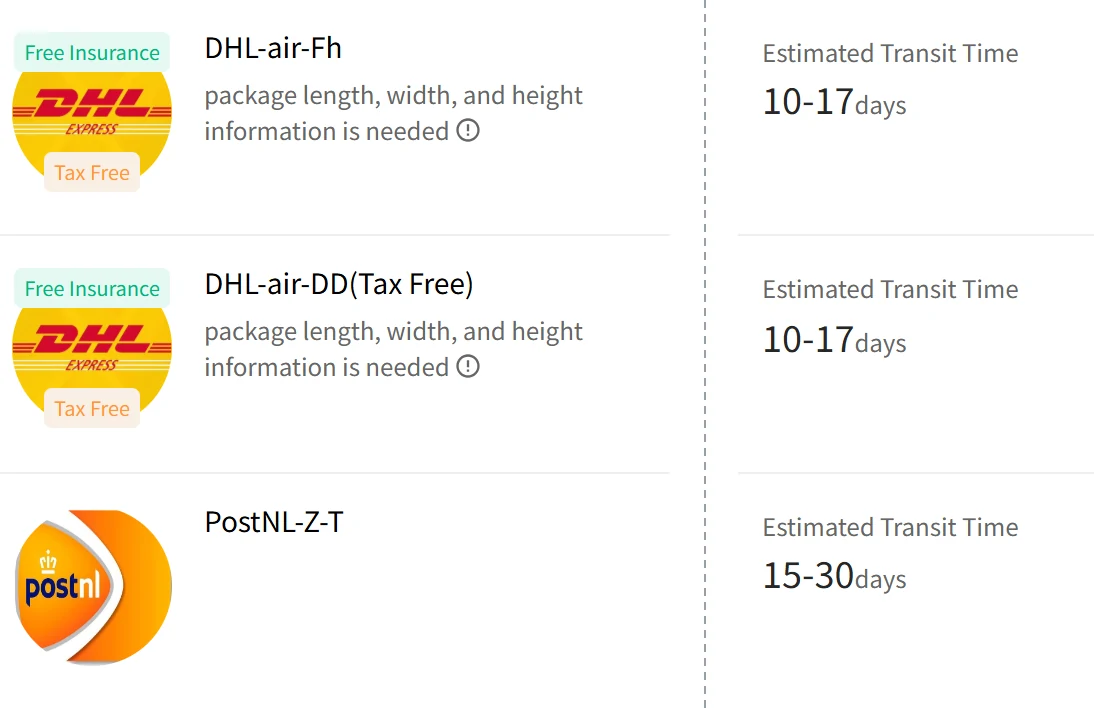
The estimator’s result card gives each line one timing figure, under the heading “Estimated Transit Time”: a range such as “10-17days”. In the data it is the field transitTime. It is the only timing figure a JoyaGoo customer sees when choosing a line.
The card does not say what the range is. It does not say whether the days are calendar or working days, when the count starts, or what share of parcels is expected inside it. JoyaGoo’s help article on shipping times sends readers to the estimator for “more specific information about the shipping time for all available routes”, and the estimator gives this range and nothing more.
The screenshot shows the German result list with the prices cut out: line names on the left, the window on the right.
Inside, outside, and across the edge
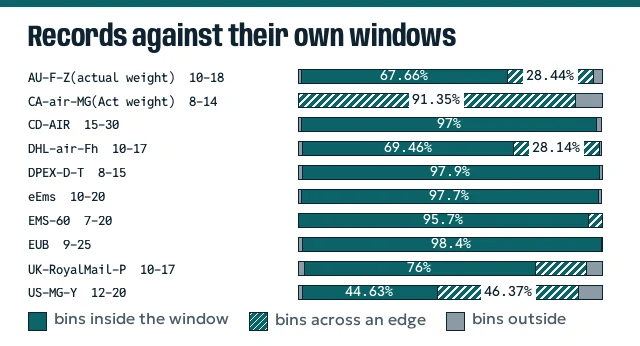
Laying the four bins over the window gives each bin one of four positions. The chart lists one line per row with its window, and colours each share by position.
Some lines line up well. EUB’s window of 9 to 25 days holds 98.4 percent of its record. eEms (10 to 20) holds 97.7, DPEX-D-T (8 to 15) 97.9, CD-AIR (15 to 30) 97.0. The numerical ranges line up; the source does not explain how either range was set.
Others do not. US-MG-Y and US-MG-H have only 44.63 percent wholly inside their 12-to-20-day window, with 46.37 percent in a 10-to-15-day bin that opens before it. The difference is not in the parcels; it is in where the cuts fall.
Canada: no bin fits inside the card window
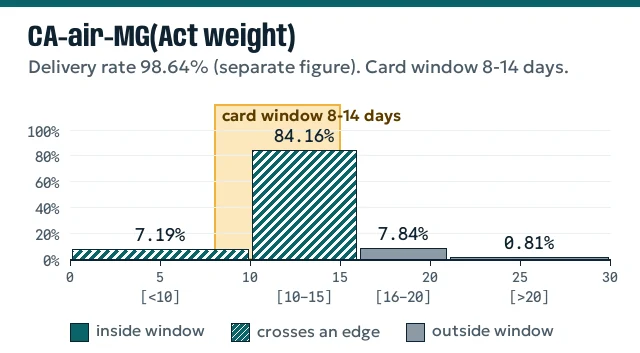
The two Canadian lines in our pull, CA-air-MG(Act weight) and its sibling CA-air-P(Act weight), both carry the Featured badge on the result card and show a window of 8 to 14 days. Their bins are cut at 10, 15 and 20.
The first bin, under 10 days, starts before the window. The second, 10 to 15 days, ends after it. The third and fourth are wholly beyond it. Not one bin is wholly inside. CA-air-P has 89.89 percent of its record in bins that cross an edge and 10.11 percent beyond; CA-air-MG has 91.35 and 8.65.
Both lines report high delivery rates (97.98 and 98.64 percent). The point is not that they are slow. It is that their window and their record speak two different languages, and the record is the one nobody sees.
The Featured badge, shown and not explained
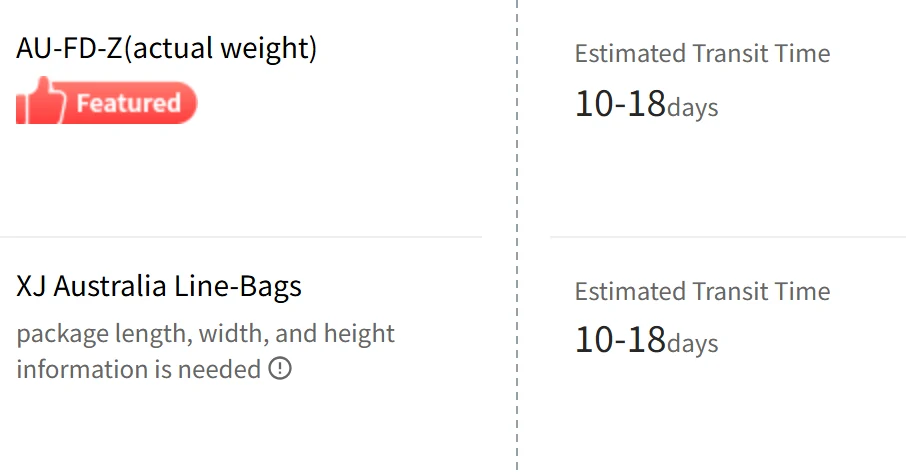
Four lines in our pull have activityType set to “Recommend”, and on the result card that value appears as a small red badge reading “Featured” with a thumbs-up. Both Canadian lines carry it (CA-air-MG(Act weight) and CA-air-P(Act weight)), and so do two of the Australian ones, AU-FD-Z(actual weight) and AU-F-Z(actual weight).
JoyaGoo does not explain the badge, and we do not either. We only place it next to the record. XJ Australia Line-Bags shares AU-FD-Z’s record exactly but has no badge; the two Canadian lines carry the badge while no bin of theirs fits their window.
Whatever the badge reflects, you cannot recover it from the delivery record.
Lines where bins and window agree
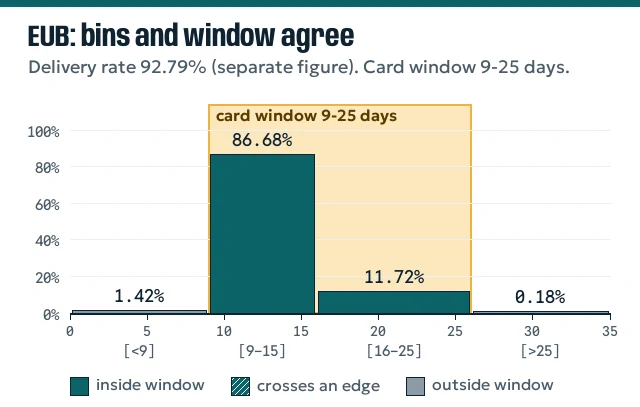
Seven records have no bin crossing an edge at all: EUB, eEms, DPEX-D-T, CD-AIR, DHL-air-Fhbig, PostNL-Z-T and the pair DHL-air-DDbig(Tax Free) and DHL-air-MGbig. For these, the share wholly inside the window can be read straight off the record, though PostNL-Z-T’s label gap sits right on its window’s opening day.
They are not all fast lines. EUB’s window is 9 to 25 days and CD-AIR’s is 15 to 30. Agreement means the window was drawn where the bins say parcels arrive, which makes the window more informative, not the line quicker.
For these lines the card window is a fair summary of the hidden record. For the others, the record adds information the card leaves out, and the curve viewer is the quickest way to see how much.
Days of which kind, counted from when
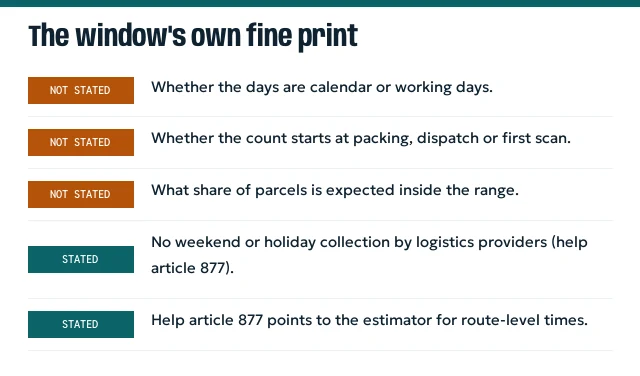
The card says “days”. JoyaGoo’s help article on shipping times says air freight “usually takes 10 - 20 days” from when the package leaves the warehouse until it reaches your hands, which suggests calendar days from dispatch. The estimator itself does not confirm either the unit or the starting point, and neither does the record.
Logistics providers do not collect on weekends and public holidays, according to the same article, so a parcel packed on a Friday may not leave until Monday. Whether those days fall inside the window or before it, nobody says.
Do not silently convert the record into calendar or working days. Ask support which clock applies to your route and allow separately for purchasing, seller dispatch and warehouse handling.
Keep reading: