

JoyaGoo Spreadsheet catalogue of time figures outside the record
The record is not JoyaGoo's only number about time. Here are the others, where each one starts counting, and why they rarely agree.
The help centre's air, sea and rail ranges
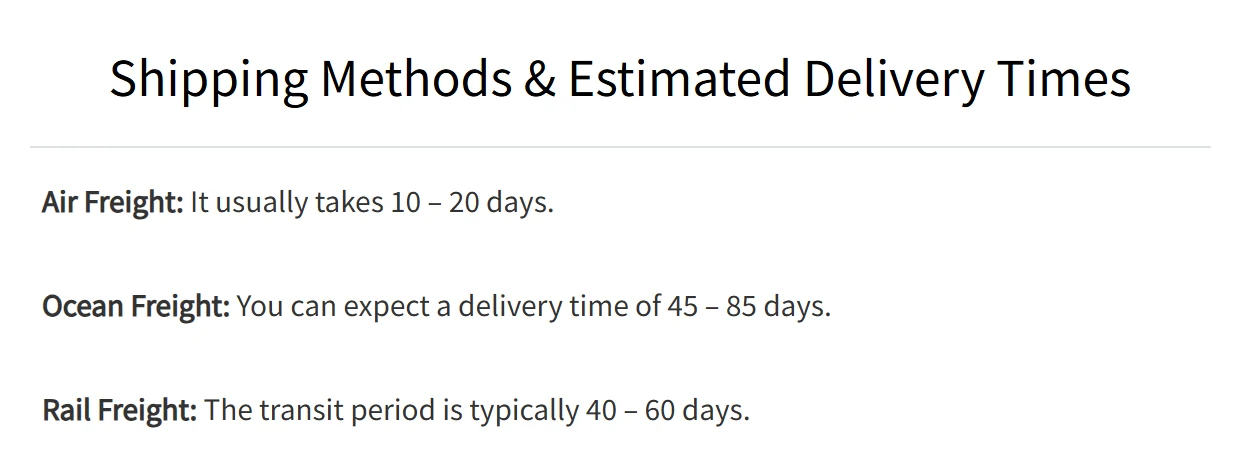
JoyaGoo’s help article “Shipping Methods & Estimated Delivery Times” (last modified 25 June 2025) gives three general ranges, measured from when the package leaves the warehouse: air 10 to 20 days, ocean 45 to 85 days, rail 40 to 60 days.
None of the 28 lines in our pull is labelled as a sea or rail service, so only the air range applies. It is wider than most card windows and narrower than most records: US-air-F’s window is 8 to 17, its record runs from under 10 to over 20, and the general range sits across both.
The same article then sends readers to the estimator for route-level detail. The estimator shows the card window, and the record stays in the data. Source: Shipping Methods & Estimated Delivery Times.
Time sentences inside the line notes
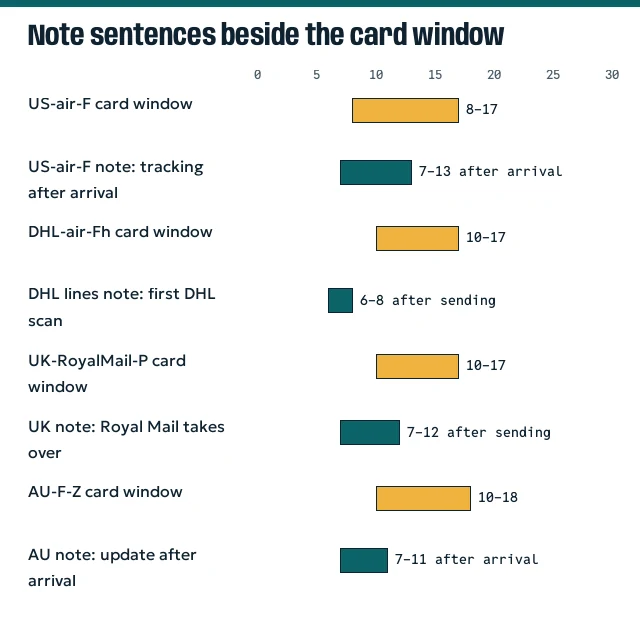
Each line on the result card carries a numbered note. Most notes are about customs, insurance and returns, which are outside this site’s scope; a few contain a sentence about time. Taken alone, those sentences add a third set of numbers:
- US-air-F: transport “more than 3-5 days”, and tracking updates in the destination country “typically within 7 to 13 days”.
- The six DHL lines: the track is not updated until DHL picks the parcel up, “usually 6-8 days after the package is sent out”.
- UK-RoyalMail-P and UK-RM-F: no update until Royal Mail takes the parcel, “usually 7-12 days after the package is sent out”.
- The three Australian lines: a further tracking update after arrival that “usually takes 7-11 days”.
- PostNL-Z-T and PostNL-B: the track can be queried “7~10 days after delivery”; EUB and CD-AIR only warn that the time is long.
These sentences describe stages, not the whole trip, and none of them is phrased as a promise.
The estimate that appears after a parcel is shipped
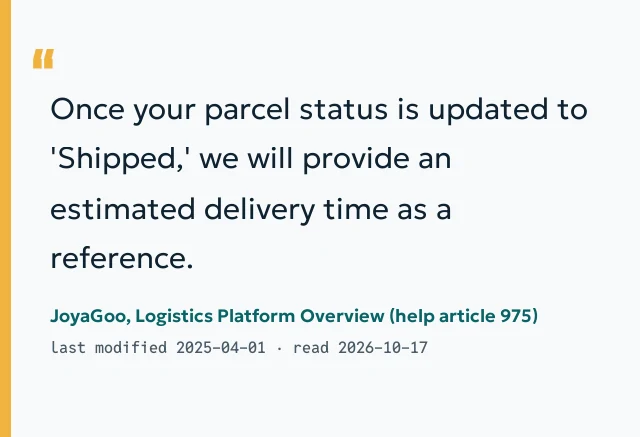
There is one more timing figure, and it lives behind the login. JoyaGoo’s “Logistics Platform Overview” says that once a parcel’s status changes to Shipped, the site provides “an estimated delivery time as a reference”. We cannot see it without an account and a parcel, so we cannot say whether it follows the card window, the record, or something else.
The same article lists nine stages from packing to delivery and says each takes time, with customs clearance the usual source of delay. It also says plainly that JoyaGoo cannot control shipping time, item limits or customs taxes. Source: Logistics Platform Overview.
If you have a shipped parcel, compare the reference date you are shown with the card window and the record for your line. We would be glad to hear how they relate.
Dated notices that changed delivery times
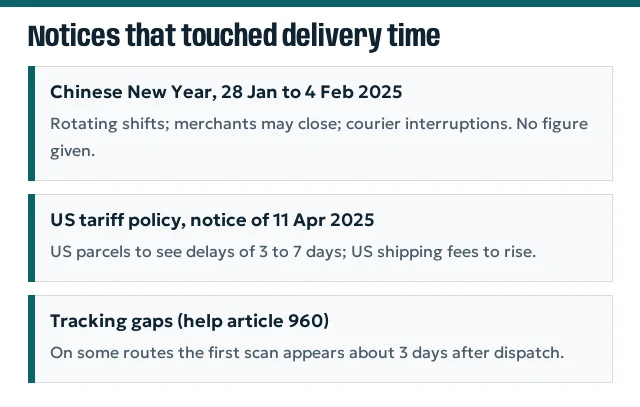
Twice in 2025 JoyaGoo published notices that put a number on a delay. The Chinese New Year notice (holiday 28 January to 4 February 2025) warned of slower merchant dispatch and courier interruptions without a figure. The US tariff notice of 11 April 2025 was specific: parcels to the United States would see “delays ranging from 3-7 days” around the 2 May policy change, alongside higher shipping fees.
Neither notice is reflected in the records we read in October 2026, which is expected for old events but tells you something: if a notice changes delivery times, the record does not carry a warning. Source: Notice on US Tariff Policy Impact.
We log any new notice that mentions delivery times on the readings log, with its date.
Four figures, four stretches of road
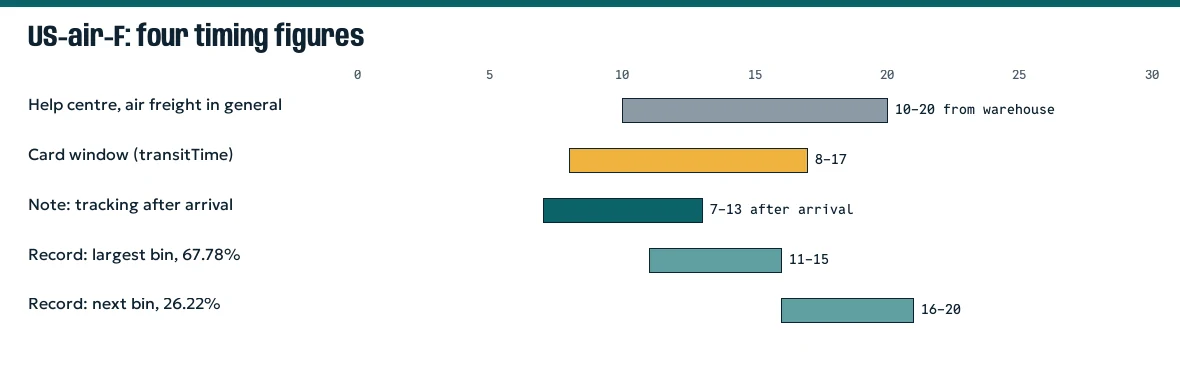
Put US-air-F’s figures on one axis and they stop looking contradictory. The help centre’s 10 to 20 days covers air parcels in general from warehouse to door. The card’s 8 to 17 days is this line’s own estimate. The note’s 7 to 13 days counts only the tracking stage after arrival in the US. The record’s bins describe when delivered parcels actually arrived, over an unknown period.
They measure different things from different starting points, so none of them disproves the others. The mistake is to treat any one of them as the answer to “when will mine arrive”.
If you want a single working figure, the record’s middle bins are the closest thing to evidence, and the card window is the closest thing to a statement. Neither is a commitment.
What these figures are not: