

JoyaGoo Spreadsheet curve viewer: one line's bins against its card window
Choose a line by name. The viewer draws the four bins JoyaGoo's estimator returns, overlays the transit window the card shows, and labels every bin against it. No ranking, no pick, no late threshold.
Pick a line, see its bins against its card window
- The record gives no period: we cannot tell which weeks of parcels it covers.
- It gives no denominator: returned, refused or disposed parcels may or may not be counted.
- It is not split by destination: the same figures come back for every country.
- It is not on the result card: JoyaGoo’s page does not display it at all.
Five steps through the curve viewer
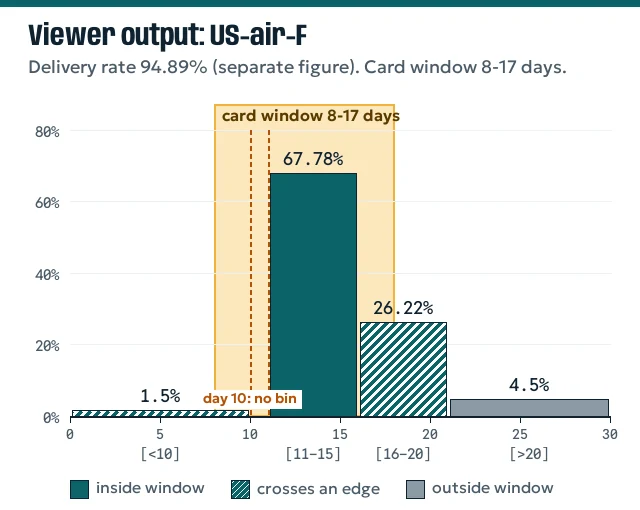
Here is how to use this tool from the first click to the last line of output:
- Choose a line name from the list. The names are JoyaGoo’s own, copied from the estimator, including oddities such as
CA-air-P(Act weight). - Read the header: the destinations that returned this line in our pull, and any other line name that came back with exactly the same figures.
- Read the chart. Columns sit where their days fall on the axis; their height is the bin’s share. The amber band is the card window.
- Read the table under it. Each bin is labelled inside, outside before, outside after, or across an edge.
- Read the label-edge line, if there is one. It flags a day that no bin covers or a day printed in two bins.
Your choice is kept in the address bar, so a link to /curve-viewer/#line=EUB opens straight on EUB.
Three labels and the one rule behind them
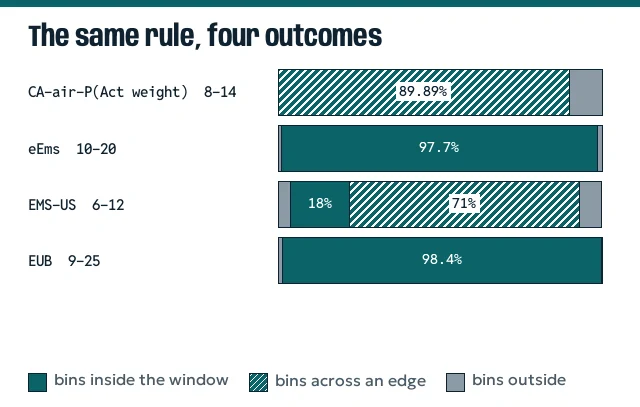
A bin is inside when its first and last day both fall within the card window. It is outside when it ends before the window opens or starts after it closes. Everything else crosses an edge, and the viewer refuses to split it, because the record gives one total per bin and nothing about how parcels spread across its days.
Open-ended bins follow the same rule. “<10” means day 9 and earlier, so against a window that opens at day 8 it crosses the edge. “>20” means day 21 and later, so against a window that closes at 17 it is wholly outside.
The chart on the right shows how differently the same rule lands on four lines. EUB and eEms are almost entirely inside; EMS-US has 71 percent in a bin that crosses the edge; CA-air-P has nothing inside at all.
Lines that come back with another line's numbers
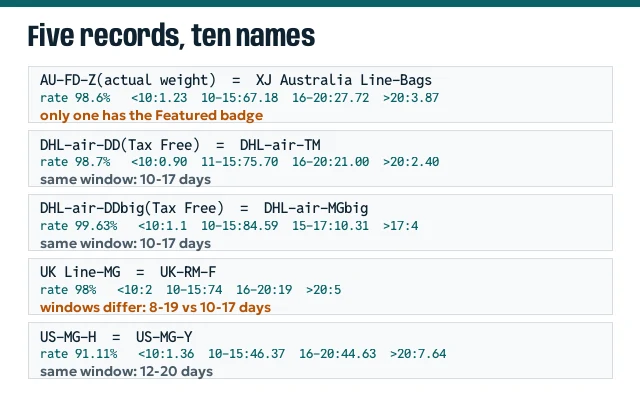
Five pairs of line names share an identical record: the same delivery rate and the same four bins to the last decimal. US-MG-Y and US-MG-H both show 91.11 percent. UK-RM-F and UK Line-MG both show 98 percent with bins of 2, 74, 19 and 5, even though their card windows differ (10 to 17 days against 8 to 19).
The most visible pair is AU-FD-Z(actual weight) and XJ Australia Line-Bags. The first carries the Featured badge on the result card, the second does not, yet their records are identical. Whatever the badge reflects, it is not something the record distinguishes.
The viewer names the partner line whenever you pick one of these, so you can see that the published values match; the underlying measurement relationship is not stated.
Questions the viewer leaves to you
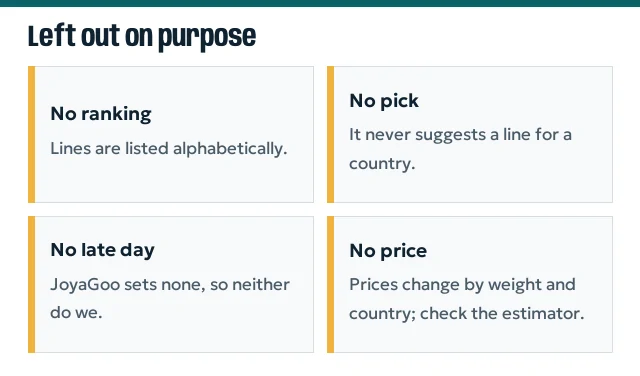
The viewer is deliberately narrow. Whether 26 percent of parcels in a bin that runs past the card window is acceptable depends on what you are shipping and when you need it, and that is your call, not ours.
It also cannot tell you which line is faster for your country. The record is the same everywhere, prices differ by destination and weight, and the descriptions add conditions such as disposal on failed delivery. Put those side by side in the estimator when you submit a parcel; the viewer only adds the piece the card hides.
Nor does it define late. JoyaGoo has no day count for that, and inventing one would turn a shaded band into a rule nobody agreed to.
Use the chart for a specific decision
If two names share a record, compare their actual route notes, charges, size limits and delivery handling instead of treating duplicate percentages as extra evidence. If a bin crosses a window edge, use the table to see which share remains unsplit; do not invent a distribution inside that bin.
For an already-shipped parcel, take its latest tracking event and shipment date to support. Neither a shaded chart area nor an open-ended tail creates a loss day or replaces the claim deadlines.
For the reasoning behind each label: