

JoyaGoo Spreadsheet account of what is not promised: no delay day, no loss day
Late parcels are a matter for negotiation, weather and customs delays are excluded, and no number of days turns a missing parcel into a lost one. The claim deadlines are the only fixed counts.
Delay compensation: negotiated, not counted
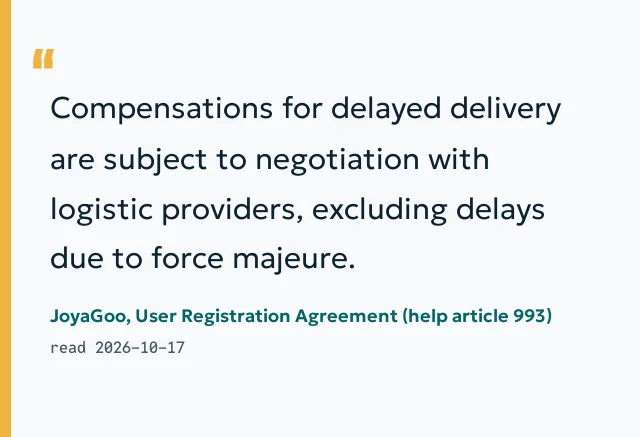
JoyaGoo’s user registration agreement gives late parcels a single sentence, and it promises nothing: whatever a late parcel earns is left to talks between JoyaGoo and the carrier, and force majeure is ruled out from the start. There is no day count, no percentage of the shipping fee, and no list of which delays qualify.
The signing notice narrows it further. It rules out compensation for delays caused by “uncontrollable factors such as weather or customs clearance”, and the published text gives those as examples, without measuring how often they occur. The international delivery agreement repeats the idea: delays beyond JoyaGoo’s control are not compensated.
So a late parcel gives you a conversation, not an entitlement. Sources: User Registration Agreement and Notices of Signing for Parcel.
No day on which a parcel becomes lost
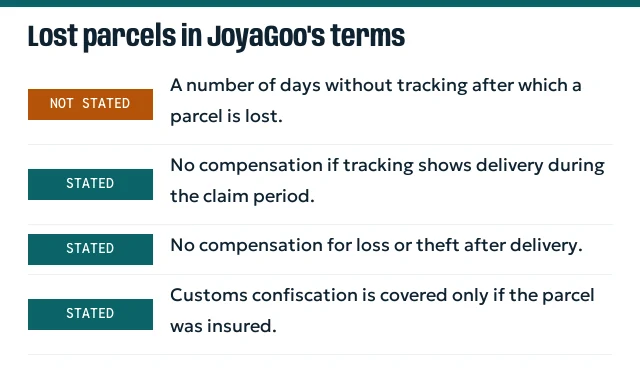
Some agents publish a rule such as “no tracking movement for a set number of days means lost”. JoyaGoo does not. We searched all 130 English help articles for any wording of that kind and found none.
What exists instead are exclusions. If a parcel shows as delivered during the claim period, there is no compensation. If it goes missing after delivery, there is none. If the carrier confirms customs confiscated it and you had no insurance, there is none.
That is why the record matters to this site. Without a rule, one per-line figure returned by the estimator is the delivery rate, and JoyaGoo has not told anyone what it measures.
The only fixed day counts are claim deadlines
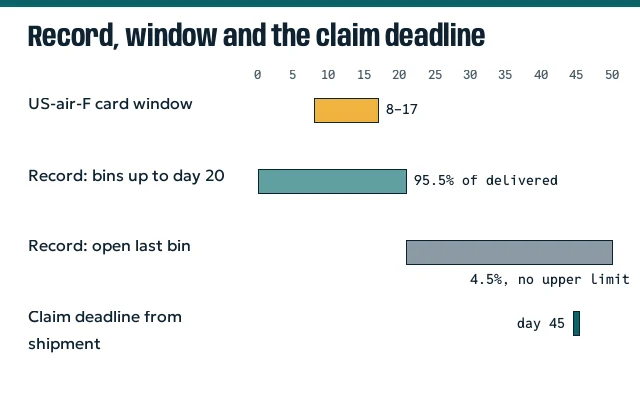
JoyaGoo does attach numbers of days to parcels in one place: claims. For both insured and uninsured parcels it accepts no claim more than a week after the parcel is signed for, nor once 45 days have passed since dispatch. Separately, problems found after delivery have shorter reporting windows; the strictest is to inspect a visibly damaged parcel in front of the courier.
Notice how this sits against the record. The record’s last bin is open-ended, so it cannot tell you how many parcels arrived after day 45. The 45-day deadline runs from shipment whether or not the parcel has arrived.
If a parcel is well past the card window and its last bin, raise it with support before day 45 rather than waiting. Sources: Compensation Standard for Insured Parcel, Compensation Standard for Uninsured Parcel.
Free insurance travels with some lines, not all
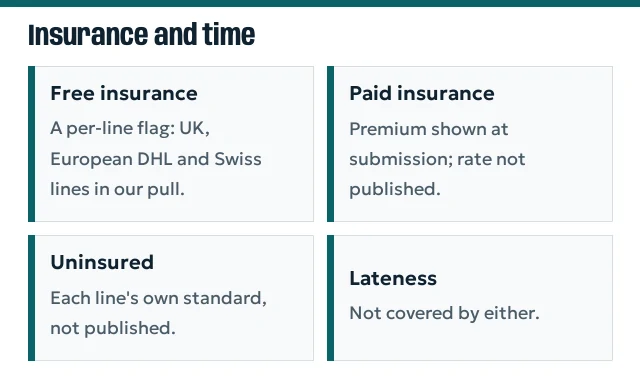
JoyaGoo’s home page advertises free insurance, but in the estimator it is a per-line flag. In our pull the three UK lines, the six DHL lines to European destinations and the two Swiss DPD lines carry it; none of the US, Canadian or Australian lines does, and neither do EMS, EUB, eEms, PostNL or CD-AIR.
Paid cover can be added at the parcel stage. The help centre never states its percentage; the premium only appears on the submission screen. Without insurance, compensation follows each line’s own standard, which JoyaGoo does not publish either.
Insurance covers loss, damage and, for insured parcels, customs seizure. It does not cover lateness, so it does not change anything on this page.
What the record cannot be used to claim
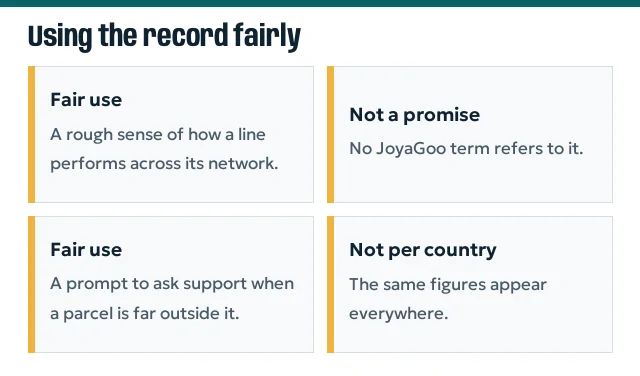
A delivery rate of 98.47 percent is not a promise that your parcel has a 98.47 percent chance of arriving. It is a figure of unknown period and make-up, attached to the line, never shown on the card, and not mentioned in any of JoyaGoo’s terms.
You cannot point support to it as a commitment, and we would not advise trying. What you can do is use it as a question: if your line reports most parcels arriving in 11 to 15 days and yours is at day 30, that is a reasonable moment to ask what is happening.
Any decision about which line to pick stays yours. We do not rank lines, and nothing on this site should be read as JoyaGoo’s assurance.
Questions worth putting to JoyaGoo support
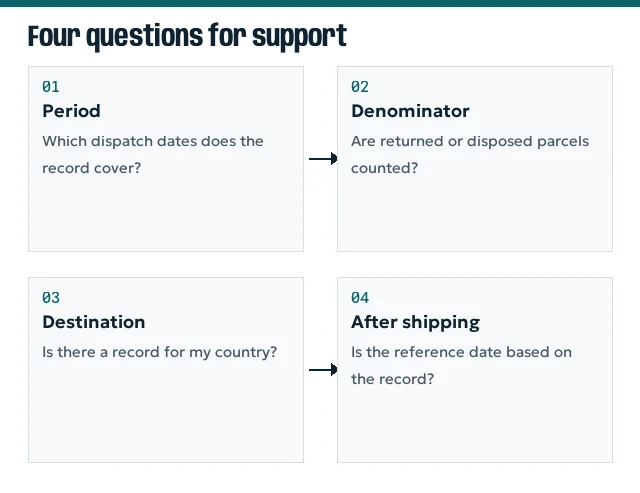
Support is reachable through the chat on the site and app and at [email protected]. Its hours are not published; purchasing runs on a Beijing working day that starts at 9 a.m. and ends at 6 p.m. (UTC+8). If you want the record to mean more, these are the questions to ask:
- Which dates of dispatch does the delivery record for my line cover?
- Are returned, refused and disposed parcels counted in the delivery rate, in the bins, or in neither?
- Do you have the record for my destination, rather than for the line as a whole?
- Is the estimated delivery time shown after shipment based on this record?
If you get answers, we would like to publish them with your permission and the date, so other readers do not have to ask again.
Back to the data: